Explore our elite selection of commercial food prep, logistics gear, and cooling systems designed to withstand intense kitchen demands.
In modern commercial culinary architecture, pharmacy environments, and logistics hubs, space is the ultimate premium resource. As real estate costs climb globally, commercial kitchens, bars, pharmacies, and specialty retail operations are moving away from massive, space-consuming walk-in units toward highly efficient, decentralized undercounter cooling configurations. Undercounter refrigerators represent the intersection of ergonomics, thermodynamic efficiency, and dynamic spatial management.
By placing precise thermal zones directly at the point of action, commercial operators eliminate unnecessary foot traffic, speed up preparation times, and maintain strict adherence to HACCP guidelines. This whitepaper analyzes the industrial landscape, safety certifications, material choices, and thermodynamic trajectories of premium undercounter refrigeration systems, serving as an authoritative blueprint for B2B procurement professionals.
The global demand for undercounter refrigeration systems is experiencing exponential growth, driven by the expansion of quick-service restaurant (QSR) chains, cloud kitchens, microbreweries, and medical laboratories. According to market intelligence, urban dense zones require compact footprints that deliver the exact cooling capacities of traditional double-door commercial cabinets.
Manufacturing clusters in APAC, particularly East Asia, lead global supply by offering vertically integrated manufacturing lines. B2B buyers require reliable logistics, custom compliance certifications (like CCC and ISO standards), and strong warranty terms before establishing a long-term supply contract.
Modern commercial kitchens rely on independent prep stations rather than a single walk-in. An undercounter unit allows chefs to store garnishes, proteins, or dairy directly beneath the preparation counter, optimizing speed and preventing thermal fluctuations from frequent walk-in door opening.
Refrigeration accounts for up to 40% of kitchen energy footprints. Advanced undercounter units utilize digital ECM fan motors, high-density cyclopentane insulation, and hydrocarbon refrigerants like R290 to reduce carbon taxes and direct utility expenses significantly.
The commercial refrigeration industry is undergoing rapid technical evolution. Over the next five years, smart sensor integrations, microchannel condensers, and alternative thermal cycles will transform standard undercounter designs.
Traditional analog thermostats are replaced by digital controllers capable of real-time cloud data logging. These modules continuously monitor internal evaporator pressure, air cycle intervals, and ambient temperatures. In the event of a sudden drop in thermal pressure or a compressor anomaly, the system automatically transmits an alert to facility managers, preventing expensive stock loss.
With the global phasedown of HFCs (hydrofluorocarbons), eco-friendly alternative refrigerants like Propane (R290) and Isobutane (R600a) have become industry standards. R290 features a Global Warming Potential (GWP) of just 3 and an Ozone Depletion Potential (ODP) of 0. Furthermore, its excellent thermodynamic properties lead to up to 20% energy savings compared to obsolete R134a systems.
High-density polyurethane foam (blown with eco-friendly agents) offers superior insulation with minimal thickness. This expands internal storage volume without changing the external chassis footprints. Heavy-duty soft-closing magnetic gaskets and micro-channel coil designs ensure the refrigeration envelope remains completely airtight.

Shandong Linru Import & Export Trading Co., Ltd., along with Shandong Binzhou Feijin Import & Export Trading Co., Ltd., is a premier enterprise integrating the advanced production, customization, and worldwide distribution of commercial kitchen equipment. Over a 15-year journey, the company has scaled from a single line of high-performance kitchen stoves to a vast, diversified portfolio of professional-grade products.
We adhere to rigorous quality protocols, ensuring that every refrigeration and heating unit meets national safety standards. We firmly believe that sustainable B2B partnerships are built purely on quality control, rejecting cheap components that lead to premature failure. Our heating and cooking ranges hold full-range China Compulsory Certification (CCC), and our commercial jacketed kettles are backed by the prestigious National Pressure Vessel Manufacturing License.
Feijin & Linru kitchen solutions are engineered in state-of-the-art facilities. Our adherence to CCC and pressure vessel certifications guarantees peace of mind for international operations under strict commercial safety inspections.
Every workbench, preparation counter, and sink accessory uses premium 304 or 201 stainless steel. High structural rigidity, premium weld finishing, and robust structural reinforcement guarantee high load capacity.
We work closely with design agencies and chain hotels. We align refrigeration dimensions, condenser capacities, voltage configurations, and door style configurations directly to client site specifications.
Undercounter refrigeration demands vary depending on the local environmental conditions and the design layout of the specific business. Below, we break down how undercounter units fit into diverse commercial ecosystems.
In compact quick-serve kitchens where every centimeter counts, standard undercounter prep tables serve dual purposes as worktops and ingredient coolers. Front-breathing configurations allow them to be flush-fit against walls or other appliances.
Craft beer bars and high-end hotels require visually striking setups. Glass-door undercounter coolers featuring internal LED illumination show product variety while maintaining rapid pull-down speeds to keep beverages at optimal service temperatures.
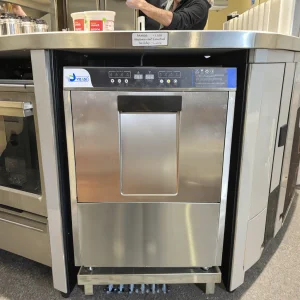
Adjacent to commercial dishwashers, structural elements must withstand high ambient humidity. Specifying premium 304 stainless steel cabinets ensures protection against corrosion from vapor and chemical exposure.
Get authoritative answers on engineering specifications, energy consumption, installation, and refrigeration configurations.
Front-breathing models intake fresh air and expel hot air entirely through the front grille. This design allows them to be built directly into counter cabinetry without leaving side or rear clearance gaps. Rear-breathing units release hot air from the back, requiring at least 2 to 5 inches of ventilation space on all sides to prevent the compressor from overheating.
304 stainless steel contains 18% chromium and 8% nickel, providing superior resistance to oxidation and corrosion from acids, food particles, and sanitizing chemicals. 201 stainless steel contains manganese instead of nickel, making it less expensive but highly susceptible to rust in heavy-duty or wet commercial environments like prep zones near dishwashers.
R290 is a natural propane refrigerant with highly efficient thermodynamic properties. It carries a low carbon index and reduces heat loading on the condenser, lowering electrical consumption by up to 20% compared to legacy R134a. This ensures full compliance with Environmental Protection Agency (EPA) SNAP regulations and European F-Gas guidelines.
B2B buyers should look for China Compulsory Certification (CCC) to ensure base electrical and structural safety. For pressure vessels, the National Pressure Vessel Manufacturing License is crucial. To import to international markets, verify that systems are certified under CE (Europe), ETL/UL (North American electrical safety), and NSF (hygiene standards).
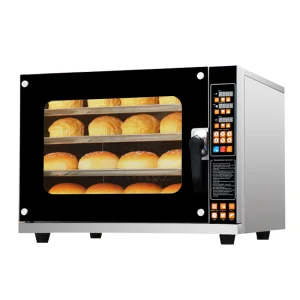
Explore our specialized heavy machinery, commercial convection ovens, dishwashers, and food-grade mixers.
 Linru Kitchen Equipment