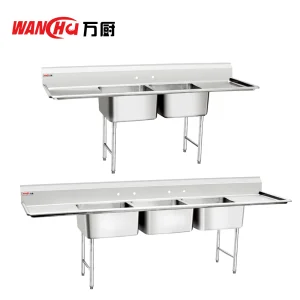
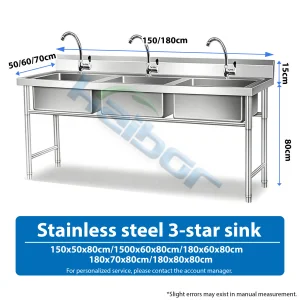
Featured Heavy-Duty 3-Compartment Stainless Steel Commercial Stations for High-Throughput Victorian Venues
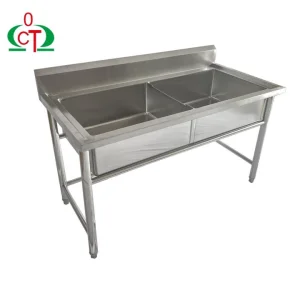
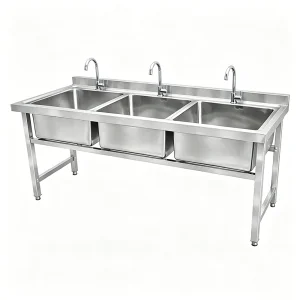
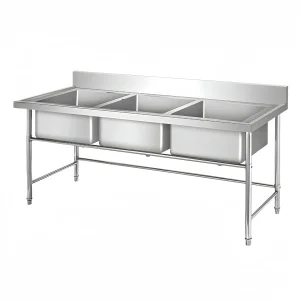
In Melbourne's world-class hospitality and food service market, hygiene compliance is not merely an operational checkbox—it is a foundational pillar of commercial survival and brand reputation. Governing bodies, such as the Victorian Department of Health and local councils, strictly enforce food safety mandates under the Victorian Food Act 1984 and the national benchmark AS 4674-2004 (Design, construction and fit-out of food premises).
Every commercial kitchen, food preparation workshop, microbrewery, and food retail space in Victoria is evaluated on its sanitation layout. A core requirement is the presence of an efficient, compliant three-compartment sink station. This setup is specifically engineered to handle the three vital stages of manual dishwashing: Washing, Rinsing, and Sanitizing. A breakdown of the process shows why each bowl is critical:
Failure to implement a compliant system in Melbourne can lead to severe operational shutdowns, heavy fines, and reputation loss. Consequently, sourcing commercial equipment that matches these regulatory standards is crucial for restaurant owners, project architects, and fit-out contractors across Melbourne CBD, Fitzroy, St Kilda, and surrounding commercial precincts.
When selecting a three-compartment sink station for the Victoria market, specific compliance metrics must be considered. First, all sink systems installed in commercial premises must feature a direct connection to a greasetrap. Water security and backflow prevention are managed via strict plumbing codes. The materials used must be completely non-porous, corrosion-resistant, and chemically inert—attributes that are only reliably delivered by high-quality, commercial-grade Grade 304 or Grade 316 Stainless Steel.
Furthermore, internal bowl corners must be coved (radiused) to a minimum of 10mm to prevent food traps and allow for easy cleaning. Traditional 90-degree square welds are prone to accumulating biofilm and bacterial colonies, which can compromise hygiene audits. Feijin's custom fabrication features fully coved corners and integrated splashbacks, ensuring complete compliance with Victorian environmental health regulations.
Shandong Linru Import & Export Trading Co., Ltd. (Feijin Brand) is a leading professional enterprise integrating the production, customization, and global export of commercial kitchen equipment.
Our heating products, including stoves, have obtained full-range CCC (China Compulsory Certification). In addition, our jacketed kettles are certified not only with CCC but also with the National Pressure Vessel Manufacturing License, ensuring customers can purchase with confidence and use with peace of mind.
For sanitation and refrigeration products, Feijin Import & Export combines high standards with customization — guaranteeing compliance with national quality standards while tailoring technical parameters to match each client's specific application and usage environment.
Feijin's stainless-steel preparation equipment is built using high-grade 304 or 201 stainless steel, with meticulous attention to load-bearing design, craftsmanship, and finishing details, ensuring both durability and aesthetic excellence.
With 15 years of experience in commercial kitchen equipment manufacturing, Feijin Import & Export is committed to continuous product refinement, rejecting low-cost, low-quality shortcuts to ensure every piece of equipment delivers long-term stability and reliability.

Melbourne's commercial sectors present unique demands for sanitation stations due to their diverse configurations and regional micro-climates. Our exports are engineered to perform in the following specific local environments:
Space in Melbourne CBD (such as Flinders Lane, Degraves Street, and Swanston Street) comes at a high premium. Kitchens are often compact and require space-saving, dual-purpose configurations. For these environments, we recommend our 3-compartment sink stations with integrated under-sink cabinet storage or double drainboards. These units serve both as sanitation systems and preparation zones, maximizing workspace efficiency without compromising AS 4674 regulations.
The rise of microbreweries in Collingwood, Brunswick, and the Yarra Valley has increased the demand for specialized, high-capacity sink systems. Fermentation by-products, acidic wort residues, and sanitizing chemicals can corrode standard metals. For these applications, we supply Grade 316 Stainless Steel Three-Compartment Sinks. The addition of molybdenum to Grade 316 provides superior resistance to chloride-induced corrosion, extending the equipment's lifespan under acidic washdown conditions.
Hospitals, aged care facilities, and schools in Melbourne's southeastern suburbs (like Clayton and Dandenong) require high-grade hygiene solutions. Sinks in these locations must feature mechanical touchless operations (sensor-activated or foot-pedal faucets), high backsplashes, and completely smooth welds to prevent bacteria build-up. Our hospital-grade medical sinks are engineered to meet these strict cleanroom and isolation-zone specifications.
The commercial food preparation equipment industry is undergoing a significant transition toward automation, material sustainability, and energy conservation. On a global scale, standard commercial kitchen manufacturing is moving away from manual operations and simple weldments. Today, advanced metallurgy and computer-aided engineering are the industry standard.
A common cost-saving practice among low-end suppliers is replacing Grade 304 stainless steel with Grade 201. While 201 is visually similar, it contains higher levels of manganese and lower levels of nickel. This composition makes it susceptible to pitting corrosion, stress cracking, and rust when exposed to moisture and industrial detergents. Feijin uses premium Grade 304 or 316 for all critical components, ensuring durability and structural integrity under constant commercial use.
In addition, our manufacturing process includes standard post-weld chemical passivation. This chemical treatment restores the chromium oxide passive layer on the steel surface, providing enhanced protection against rust and corrosion near welded joints.
Explore our complete export catalog, designed for Melbourne's strict commercial, industrial, and medical environments.
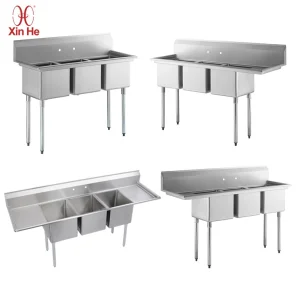
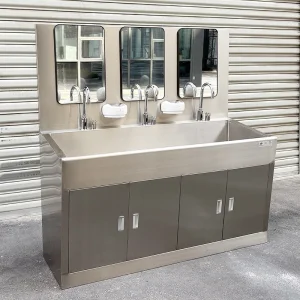
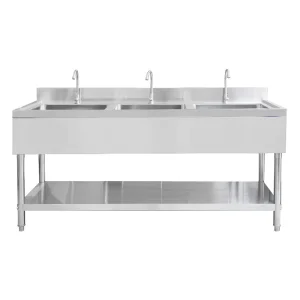
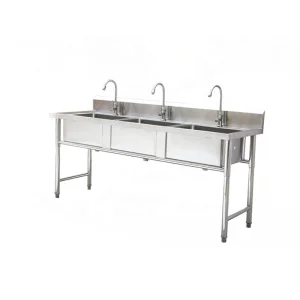
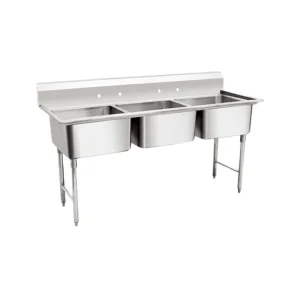
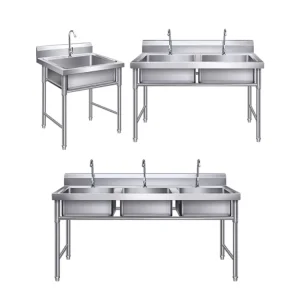
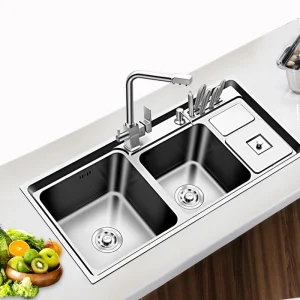
The design of commercial kitchen sanitation stations is evolving beyond static metal basins toward integrated, intelligent utility systems. At Feijin, our research and development focuses on the following key engineering initiatives:
Drainage design directly impacts kitchen turnaround speeds. Traditional flat-bottom sinks can lead to standing water, which increases bacteria growth risk. Our modern sink basins feature laser-etched pitch lines that slope toward the drain, ensuring complete drainage even under low pressure. We also integrate multi-tiered strainer baskets to trap food waste and prevent commercial grease interceptor blockages.
Heating water accounts for a significant portion of a commercial kitchen's energy footprint. Our future development roadmap includes integrated heat exchanger channels within the splashbacks and undersink assemblies. This design pre-heats incoming fresh cold water using the thermal energy from draining wastewater, reducing energy consumption for commercial hot water systems in Melbourne.
Commercial kitchens subject sinks to heavy, continuous impacts from large cookware and utensils. To prevent bowing and warping, our stations are reinforced with under-bowl sound deadening pads and structural channels. This construction minimizes clatter noise and increases the sink's load capacity, preventing long-term warping.
Exporting heavy stainless steel structures requires robust packaging and reliable logistics. Shandong Linru utilizes shipping routes from Qingdao Port to the Port of Melbourne, working with reliable freight partners to ensure damage-free transit. All products are wrapped in thick protective film, secured inside reinforced crates, and packed to prevent movement inside the container. We also provide full documentation support—including Certificates of Origin and Bill of Lading details—to facilitate smooth customs clearance at the Port of Melbourne.
Find answers to common questions about regulatory compliance, shipping logistics, and customization options for commercial sinks in Victoria.
Under the AS 4674-2004 standard, commercial sink compartments must be large enough to fully submerge the largest pot, pan, or food prep utensil used in the kitchen. For standard commercial venues in Victoria, this typically translates to minimum bowl dimensions of 500mm x 500mm with a depth of 300mm. We offer customizable dimensions to ensure your configuration matches your largest cookware.
Grade 304 is the industry standard for commercial kitchens, providing excellent resistance to rust and oxidation. However, for venues located near the coast (such as St Kilda, Brighton, or Geelong) or operations handling highly acidic foods (like citrus processing or fermentation), Grade 316 is recommended. Grade 316 contains molybdenum, which prevents pitting corrosion from airborne salts and harsh chemical cleaners.
Yes. Sinks exported to Australia are configured with pre-drilled tap holes designed to accommodate standard Australian tapware, including WaterMark certified pre-rinse spray units and mixer taps. We work closely with Melbourne project contractors to ensure tap hole sizing, spacing, and splashback mounting locations align with local plumbing requirements.
For custom configurations, design approval and manufacturing typically take 15 to 20 days. Ocean freight transit from Qingdao to the Port of Melbourne takes approximately 18 to 22 days. In total, clients should plan for a lead time of 5 to 7 weeks from design sign-off to port arrival. We provide tracking updates throughout the transit process.
We reinforce our workbenches and sink tables using heavy-gauge stainless steel under-channel supports. The legs are made from 1.5mm thick stainless steel tubing, fitted with adjustable bullet feet for leveling on uneven floors. We also apply high-density sound-deadening rubber pads to the underside of each sink bowl to absorb vibrations and reduce noise.
Yes, our commercial sink designs follow the guidelines specified in AS 4674. Features include coved internal corners (radius > 10mm), an integrated rear splashback, and grade 304/316 construction. These specifications help ensure smooth sign-off during local environmental health inspections in Victoria.
 Linru Kitchen Equipment